Have you ever had a problem to choose correct trim for your renaissance dress or even to to buy the most accurate one? I have to admit that I had this problem and still have. I have spent many hours on the internet and in the shops and I have found just poor imitations of real historical trims.
I am very fond of renaissance trims and I decided to have a closed look on renaissance paintings and re-draw the details. With this I would like to make a sampler to help me and you with recreating renaissance dress in the future :-).
… a book which help you to make a historical patterns…
This book is base for historical dress lovers library. The book is practical guide for recreating period costumes from short Saxon tunics from 5th century to a lady`s bustle dress of late 19th century. 158 pages contain text describing parts of the garment supported by paintings and illustrations.
The text is supplemented by authentic patterns, their size, materials requirements and methods of sewing.
The sewing patterns are drafted very simply however it can be challenging for those who are not much experienced with pattern scaling and designing. The first piece to practice sewing pattern drafting you may choose a tunic for woman or man, for example the one which is on the picture above.
The book contains basic knowledge on clothing and patterns and it is good start for beginners. You will not find all information and more research needs to be done to get details on embellishments, jewellery or headdress.
How we can prepare for sewing and what we need to think ahead.
After New Years Eve we have a habit to set goals and we are full of energy to complete them.
In this blog post we will choose a sewing project and I will talk about the sewing historical costume and how we can make our dream garment real. I will make step by step guide and I will mention all the feature we need to be aware of before starting the project. We need to keep in mind that we make no more than illusion of accuracy.
And why is that?
We are not able to recreate the same fabric quality or color shade or even to repeat hand craft. Nevertheless, there are human beings who are still digging in historical records and bringing them back to life :-).
Let`s start … and … have fun…
Historical period – when we start to sew any historical dress, in most of the time we know exactly which historical period it will be. For example fencing or dancing historical groups are focused on specific era or film producers also know what the story will be about.
I am very attracted by Jane Austen novels and Regency era and I really want to have it in my historical wardrobe. :-). I have to admit that I have not sewed Regency dress yet. I will go with you through this process and I will pick a dress to prepare for the sewing project.
Sources – the most accurate information and details we can get from paintings, fashion museums and archives. You may observe the real dress which were worn, it`s style, shape, color, hair style and accessories. The other good sources are books and internet. The advantage of internet is to get wide range of digitized documentations.
Purpose – with selecting the dress we also need to take in mind the dress purpose we want to present – it can be dress for common daily use, morning dress, riding habit, ceremonial garment, ball gown, working dress, hunting dress etc. …
Choosing the dress we like, we want to sew and dress can take more time than we could expect. To search the dress which catches your eye can take several hours or days.
I have fallen in love with the dress of Louise-Elisabeth Vigée-Lebrun (1755-1842), The Duchess of Berry in a blue velvet dress from 1824:
The painting shows us upper part of the body, so we do not know how the bottom part of the dress looks like and even we can not see the shoes. We will need to make more research on that…
Pattern – we can use modern sewing patterns with all sizes or books with sketches and scaling. There are many possibilities to get the pattern and also they are affordable. In case you are advanced tailor, you will be able to make the pattern by your own or at least to amend the one you have.
The dress I have chosen has simple silhouette but do not deceived yourself. An easy sewing can be also tricky.
Layers – the painting show us outer garment only. To be as much as accurate, we need to do more research on undergarments, such as corset, petticoat, stockings, …
Color – it is very important visual part of the dress. Each of the historical period has specific colors which were worn. Also each color has it`s own meaning and it is worn on specific events. The color also reflects our social status. In case I would like to make royal garment, no one will be surprised I will select royal blue, red or golden.
Fabric – sewing historical costumes requires accurate fabric quality. There are many fabric imitations using polyester. Focus more on good quality cotton, silk, brocade, damask, taffeta, cotton velvet, linen, wool, leather. Even the prices are higher but it is worth it. We have not to forget calculate how much fabric we will need. In case we will wash the fabric before sewing, we need to buy few more centimeters/inches. Before buying the fabric, verify how the fabric should be maintained. For example, silk should never be washed. And on the other hand linen or cotton should be always pre-washed. Cotton fabric shrinks with washing and also manufacturing coloring needs to be stabilized.
Accessories and embellishment – when we have your project prepared, we have to complete the look with headdress, jewellery, shoes, bags, belts, shawls, embroidery…
Each historical period has it`s own characteristics we need to follow. To select, prepare the sewing project and buying the materials is more time consuming than the sewing it self. Try to not rush this part because you long for dress to be as good as a real historical person.
“There is nothing hidden that will not be revealed . . .”
The TV mini-series were filmed in 2017 based on the book by Jessie Burton.
Book cover
First I picked up this book to my “to be read” pile, I really did not know what to expect. By the cover book it seemed it will be just another historical novel. To my surprise I read the book by one breath. It has mystery, drama and also showing the Amsterdam society in late 17th century.
… how good inspiration for a movie …
staring Anya Taylor-Joy, Romola Garai and Alex Hassell. Credit for costume design has Joanna Eatwell.
Many of us have a thought that Dutch fashion was just dark without any bright colors however the paintings show that there was large scale of colors …
… white, yellow, orange, red and blue. We can also see common features of women`s garments … wide and low neck line, wide sleeves with opening at the front, two-pieces garment in two different colors and the skirts decorated with two or three trims stripes.
And here is how the costume design started … with inspiration board…:
… and this the result …
In this case I will not miss costumes in black color … 🙂
Now I wish you to have a fun watching this historical mystery.
The most significant doll in history is “Lady Barbie” which is with us over 60 years. As a “doll fashion icon“, she has extensive wardrobe. It contains ready to wear, sport wear, movie costumes, evening gowns… and… my favorite ones… historical costumes. There are also other “Lady Dolls” which have historical wardrobe also.
It is marvelous how detailed these small garments are done. Barbie doll is approximately 30 cm tall (11 inches) what can make sewing very small sizes quite challenging :-). Most of the sewing needs to be done by hand and using a glue is also required. You will be in need of enough time, a lot of patience, good eyes and gently hands.
Do you have any cloth left-overs to make a smaller version of your favorite historical dress?
Can we consider the clothes to cover our bodies only? … to protect ourselves against bad weather? … to pretend it is just practical part of our lives? … is it the sing of our tribe we belong to? … do we need someone to be afraid of us? …
After all these question comes one more: “How we can express our social caste and our material prosperity by wearing clothes?” The answer to this question is related merely to rich merchants, aristocracy and royal family.
We should not replace wealth with power or authority – religious significance or military. Also nice dress does not guarantee popularity.
During 13th century there were laws related to luxury regulations. It means that middle class was not allowed to wear certain colors, style and ornaments.
Here we have six signs of Medieval prosperity and abundance:
Samite is a rich silk fabric interwoven with gold and silver threads, used for dressmaking and decoration in the Middle Ages.
Vair is a fur, typically bluish-gray, obtained from a variety of squirrel or ermine, used in the 13th and 14th centuries as a trimming or lining for garments.
Do you know an ermine? It is a stoat with white fur and with black tip of the tail:
The garments were very expensive because for trimming and lining was used a tail with the black tip only. Can you imagine how many tails were needed to decorate one garment? … Unfortunately, there were no animal protectors in Medieval age to save these small cute species.
The crown of gold or silver
Extended back part of the dress was another sign of the wealth of the lady. The longest back part, the richer the lady was. She was so moneyed that she could afford to buy much more fabric.
Gold and precious stones
And finally gold embroidery.
This beautiful embroidered sleeve is part of restored blue tunic from 12th century.
What you would dress to show your status and wealth?
There are many extravagance fashion pieces which we wear in these times and also which were wore in the past. They had many forms, shapes and color. The skirt is the most significant piece of woman`s wardrobe.
The history showed us various shapes of skirts and … sizes … as these ones…
We may ask the question … : How it is possible the skirt keep such a shape?… The answer is … : A pannier or side hoops. (for example the one on the picture)
The panniers were worn as undergarment. The main purpose was to extend the size at the side and leave back and front flat.
The pannier came into fashion in Spain first in 17th century. And then it spread to France and the rest of the Europe. It stayed in French fashion till the reign of Louis XVI and Marie Antoinette.
The skirts were so wide that a woman took much more space around her and she could not walk through the door. The skirts reached up to 150cm :-0.
Could you imagine walk through the door sideways?…
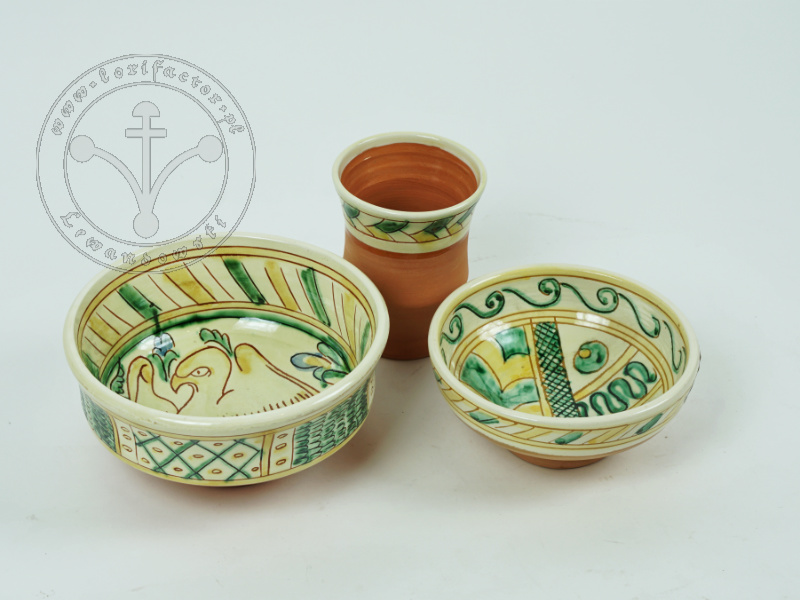
Lorifactor.com is an e-shop offering historical replicas mainly from Medieval age. The replicas are done based on archeological and pictorial sources.
Among selling products you will find belts and knight’s girdles, accessories for belts, armor and dress such as buckles, mounts, buttons etc. and also items of everyday use and weapons such as knives, candlesticks, camp accessories, pottery etc.
Nice approach is done for example with buckles. You may choose from three variants: brass, silver and gold.
Lorifactor is based in Poland (but do not worry, they ship the products also abroad). The products can be ordered throughout Europe in different currencies such as EUR, USD, GBP and CZK, SEK, NOK also.
Collecting and preserving western clothing through the centuries
As the name of the museum states, KCI is based in Kyoto Japan. The main activity of this institute is collecting and preserving western clothing through the centuries. Furthermore the institute collects documentation, does research, exhibitions and publishes its findings.
Kyoto institute has solid costume collection which up today contains 13 000 items of clothing and 20 000 documents. Nowadays, traveling to see whole beauty is just our dream. Thankfully we have an internet and digital archives. Click here and observe the collection and get inspiration. I have selected several of my favorites:
Major exhibitions related to historical costumes which I would like to mention are: Evolution of fashion 1835 – 1895, Revolution in fashion 1715 – 1815 and Vision of the body: fashion or invisible corset.
Kyoto Institute published two-part book collection “Fashion – A History from the 18th to the 20th Century” (2006), including items photos from the 18th century to the present day.
There is another book titled “Fashion – A History from the 18th to the 20th Century” 🙂 (2015).
And the third book with the very same title “Fashion – A History from the 18th to the 20th Century” was published in 2019. All these books have been published in cooperation with Taschen.
I hope KIC and its publications will enlarge your historical dress research sources.
Inheriting Burgundian lands, she was titled as Mary the Rich.
Mary was born in 13 February 1457 in Brussels and she was the only child of Duke of Burgundy. She got married to Archduke Maximilian of Austria. Despite their short marriage they had 3 children.
Mary had unfortunate fate in her your age. She had tragic accident while hunting in the woods near Wijnendale Castle in Belgium. She died from internal injuries, at her 25 in 1482.
Now let`s learn more about Burgundy fashion and Mary is superior representative of this time period. Burgundy fashion style had dominance in Europe in late Medieval age and it has it`s own characteristic silhouette.
Women`s Burgundian dress had fur-trimmed V-neckline that displays a kirtle, the outer garment is banded with a wide belt. Hair was covered with hennin and a veil on top of it.
Throughout Mary`s life square necklines were in fashion as well.
Another fashion detail of the second half of 15the century is a dress with low front opening and laced across a kirtle.
Just by chance I have found mini series about Mary`s life and her marriage with Maximilian titled: “Maximilian: Das Spiel von Macht und Liebe” (Maximilian & Marie De Bourgogne), filmed in Austria in 2017, with original spoken language German.
One can be surprised how the fashion varies in few decades during late 15th century.






 ajournalofhistorian.home.blog