Medieval Costume and How to Recreate It

Written by Dorothy Hartley

This book is another one about medieval dress however it has fresh approach. It classifies the clothes and accessories from 12th till 15th century. You can read about the wardrobe of nobility and peasants also. The book contains descriptions, photos, painting sculptures and illustrations too.

Along with pictures, the book brings clear drawings showing silhouettes and fabric cutting, placement of seams, draping and folding garments. The illustrations are very good guide for recreating Medieval garments.

This book can be very valuable for those who are interested also in dressing of for example peasants. You can find here also clothes for sports, travelers or children for which the information is more difficult to obtain. Even the book has just 140 pages, it is complex and can be your good friend.

Enjoy 🙂

Historic Costumes and How to make them

… a book which help you to make a historical patterns…

This book is base for historical dress lovers library. The book is practical guide for recreating period costumes from short Saxon tunics from 5th century to a lady`s bustle dress of late 19th century. 158 pages contain text describing parts of the garment supported by paintings and illustrations.

The text is supplemented by authentic patterns, their size, materials requirements and methods of sewing.

The sewing patterns are drafted very simply however it can be challenging for those who are not much experienced with pattern scaling and designing. The first piece to practice sewing pattern drafting you may choose a tunic for woman or man, for example the one which is on the picture above.

The book contains basic knowledge on clothing and patterns and it is good start for beginners. You will not find all information and more research needs to be done to get details on embellishments, jewellery or headdress.

Enjoy the reading 🙂

The Kyoto Costume Institute

Collecting and preserving western clothing through the centuries

As the name of the museum states, KCI is based in Kyoto Japan. The main activity of this institute is collecting and preserving western clothing through the centuries. Furthermore the institute collects documentation, does research, exhibitions and publishes its findings.

Kyoto institute has solid costume collection which up today contains 13 000 items of clothing and 20 000 documents. Nowadays, traveling to see whole beauty is just our dream. Thankfully we have an internet and digital archives. Click here and observe the collection and get inspiration. I have selected several of my favorites:

Major exhibitions related to historical costumes which I would like to mention are: Evolution of fashion 1835 – 1895, Revolution in fashion 1715 – 1815 and Vision of the body: fashion or invisible corset.

Kyoto Institute published two-part book collection “FashionA History from the 18th to the 20th Century” (2006), including items photos from the 18th century to the present day.

There is another book titled “FashionA History from the 18th to the 20th Century” 🙂 (2015).

And the third book with the very same title “FashionA History from the 18th to the 20th Century” was published in 2019. All these books have been published in cooperation with Taschen.

I hope KIC and its publications will enlarge your historical dress research sources.

The Complete Costume History by Taschen

The book full of historical dress drawings

There are many books about the historical dress with illustrations and pictures with paintings and you can choose any you like the best. Taschen publishes books about all types of arts. One of the area is fashion. The book “The Costume History” brings over 700 pages of illustrations (colored and black and white). The Mmjor content is about historical dress (of course) from Egypt till Regency era.

Why till Regency era only?

It was written by Auguste Racinet the first edition was published between 1876 and 1888 so do not look for Victorian fashion in this book. Good job Mr. Racinet anyway.

The book contains much more than costumes. It contains also interior illustrations, dishes and other needs of daily life.

We know a lot about the European historical dress. With this book we can get more information about dressing up out side of Europe and other regional national costumes.

There are not just fancy dress. An armor and weapons are part of our history. The warriors and soldiers need to be dressed too. :-))

Even the book is full of illustrations, you may read short notes bringing more details of the pictures and life style.

Will you visit your library or bookstore to read the book?

Period Costume for Stage & Screen

Patterns for Women`s dress Medieval age – 1909

Jean Hunnisett is an author of Period Costume for Stage & Screen book series. There are five books which cover period from Medieval age till 1909.

The first book covers period from Medieval age till 1500, the second one is from 1500 till 1800 and the third one is from 1800 till 1909.

The other two books contain patterns for outer garments.

Today we will have a look in to the second book – from Renaissance till Rococo.

The part one describes the techniques of the costume making such as the interpretation of the dress, choosing appropriate fabric, draping, step by step of bodice making, fitting and finishing, making petticoats, pads and chemise.

And the second part contains the patterns. For help to make your own pattern there are simple nice drawings and scales. Do not worry, there are not just drawings. There are also step by step descriptions. All this you can read on almost 170 pages.

I would like to make a note that Jean wrote all these books from her own experiences. She did costume design for movies such as Joseph Andrews (1977), Elizabeth R (1971) and The Slipper and the Rose: The Story of Cinderella (1976).

Joseph Andrews:

Elizabeth R:

The Slipper and the Rose: The Story of Cinderella:

We have to realize that costumes for stage and screen are not always historically accurate however I dare say that all the Jean`s books have very solid basics to achieve your sewing goals.

Have fun with sewing 🙂

A Dictionary of Costume and Fashion

What a mushroom hat is?

Is it this one?

NOOO!!!

I would advice you to have a look into s dictionary….What I mean exactly?…

A Dictionary of Costume and Fashion (Historic and Modern)

What stays in this dictionary about mushroom hat?

Hat with downward cured brim shaped like mushroom or toadstool, sometimes wider at sides.

And how it looks like?

Just like this:

What about other fashion expressions?….You can look them up in Dictionary of Fashion…..

Each fashion term is described and some of them has simple black and white picture.

You can also look up for types of stitches:

The dictionary contains also black and white painting pictures:

Would you like to know how silhouette developed through the centuries?

This dictionary contains much more, for example fairy tail or national costumes….(if you are interested …)

What fashion expression you do not know what means?

Regency women’s dress – Cassidy Percoco

Who would not love Jane Austen era?

The book “Regency women`s dress” shows dress patterns from 1800 to 1830. There are 26 patterns of morning dress, evening dress, ball gowns. Also it includes patterns of chemise, corset, spencers and coats.

Firstly, each dress is shortly described and illustrated. Cassidy provides very useful information about fabrics, lining, embroidery, hems, dress structure and sewing techniques.

Next two pages shows pattern in grid. As it is one size pattern, it requires small effort to resize it to be fitted for you.

Even the book time period is short, I recommend to have it in your bookshelf. It is very good reference for all who sew regency dress.

Which of Jane Austen books do you like most?

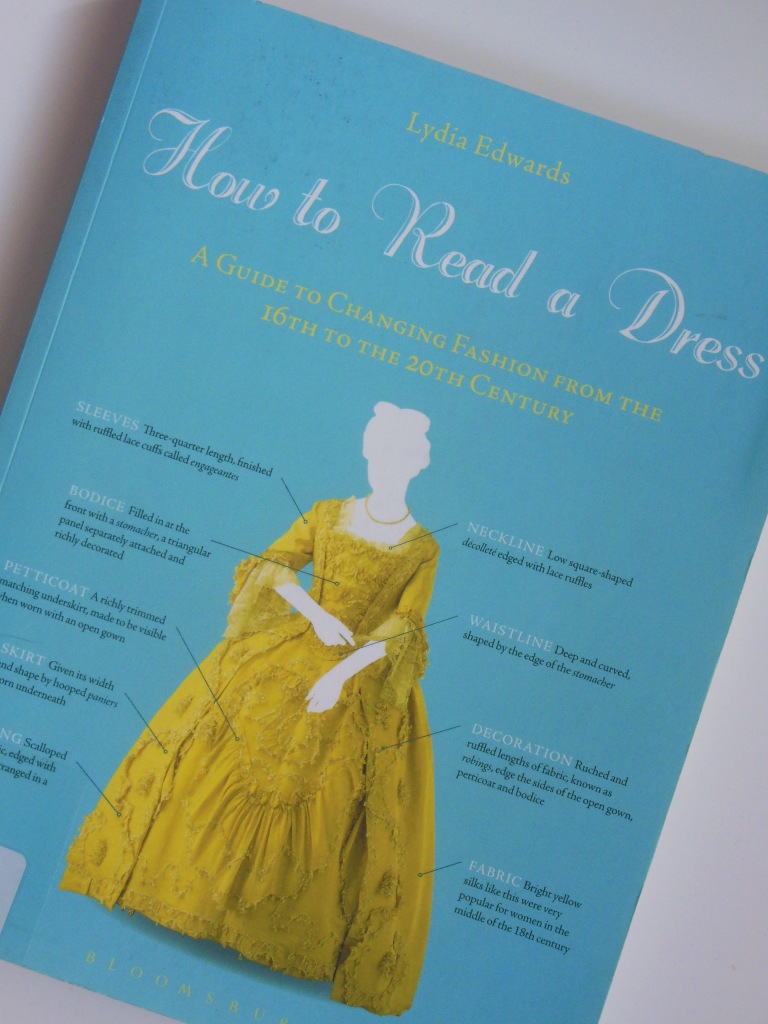
How to read a dress – Lydia Edwards

A few weeks ago, I came across a book – How to read a dress written by Lydia Edwards and I would like to share with you my impression.

Before we start to be fully engaged to historical costumes, we need to learn what we see on portraits, fashion plates or real dress exhibited in museums. And here is the question: “How to read what we see?”

This book is full of photos of real garments from the 16th to the 20th century exhibited in the museums all over the world, let`s mention Victoria and Albert Museum – London, McCord Museum – Montreal, Swan Guildford Historical Society – Western Australia. All pictured dress have short description dress itself and description of neckline, sleeves bodice, skirts, trims, fabrics…

When I found this book, I expected the book will contains more details a deeper description such as folding fabric, layering, gathering ruffles etc. In my opinion, there is little information about that. The dress are described in very simple way for example „a square-shaped neckline“, „rounded skirt silhouette“.

I would recommend this book to beginners as the book contains vocabulary related with fashion and historical facts and the pictures show historical features of particular era.