Do you remember how you dressed your paper doll with paper dress when you was a child?
When I was a child I loved it. I drew princess dress, evening garments and many other clothes. And then I dress my paper doll. In some way, it looked like this :-)…:
There is someone who remake this children’s entertainment put it on higher level…
Isabelle de Borchgrave was born in 1946 in Etterbeek. She is a prominent Belgian artist and sculptor, She does colorful paintings and intricately painted paper sculptures. She graduated the Royal Academy of Fine Arts in Brussels.
After graduating, Isabelle set up her own studio focusing on fashion and interior design. In 1994 began to design paper costumes. The first collection named ‘Papiers à la Mode’ (Fashion Art from Paper), was a collaboration between the artist and Canadian costume designer Rita Brown, covered fashion from Elizabeth I to Coco Chanel.
The collection traveled across the world from 1998 to 2008. And now in 2021, you can admire the Isabelle`s work with me.
It is absolutely unbelievable we are looking at dress made of paper. To make origami is very difficult for me even it is done in small size. Making historical garments … is a little bit larger project …To do such amazing art you need to be very good friend of paper and to know it `s features and quality. A dress, jewellery, headdress, shoes … everything you see is made of paper.
When I look at the dress I can see perfect replicas of historical dress. So the question is: “How the garments are done?”. Isabelle studied painting and drawing so she has very good starting point to paint all the fabric patterns by hand. For painting, an ink is used. After the painting the paper is ironed to archive the texture.
I would like to tou…..
Hey! Do not touch! You may tear the paper! 🙂
Would you like to see more and flip through the nice colorful books? You may obtain one of these three books: Isabelle de Borchgrave: Fashioning Art from Paper, Pulp Fashion: The Art of Isabelle De Borchgrave or very fun and interactive one: Fashion a la Mode: The Pop-Up History of Costumes and Dresses.
It is said that fashion returns. It does not mean that we start to wear corsets or hoop skirts. I just wanted to say that modern fashion is inspired by small elements () of historical dress. Currently there is retro fashion very popular. We recycle fashion from 20th century which we can easily wear on daily basic. Today we will go higher and have a look at Haute Couture fashion stage.
World famous fashion designers take inspiration basically from everywhere and transfer their ideas into master pieces. I am absolutely amazed how big their imagination is and how endless creativity they have.
Let`s explore how fashion designers are able to recreate inspirations from historical dress into (not wearable :-)) High Fashion …
D&G 2019
Elie Saab 2017
McQueen 2013
Dior 2007
Galliano 1998
Guo Pei 2010
Could we transfer these dress into ready to wear clothes?…
I have started to look for renaissance trim to help me with reconstructing renaissance dress. If you missed the first part, you may read it here. This time I picked all the trims golden on black background :-).
Have you ever had a problem to choose correct trim for your renaissance dress or even to to buy the most accurate one? I have to admit that I had this problem and still have. I have spent many hours on the internet and in the shops and I have found just poor imitations of real historical trims.
I am very fond of renaissance trims and I decided to have a closed look on renaissance paintings and re-draw the details. With this I would like to make a sampler to help me and you with recreating renaissance dress in the future :-).
… a book which help you to make a historical patterns…
This book is base for historical dress lovers library. The book is practical guide for recreating period costumes from short Saxon tunics from 5th century to a lady`s bustle dress of late 19th century. 158 pages contain text describing parts of the garment supported by paintings and illustrations.
The text is supplemented by authentic patterns, their size, materials requirements and methods of sewing.
The sewing patterns are drafted very simply however it can be challenging for those who are not much experienced with pattern scaling and designing. The first piece to practice sewing pattern drafting you may choose a tunic for woman or man, for example the one which is on the picture above.
The book contains basic knowledge on clothing and patterns and it is good start for beginners. You will not find all information and more research needs to be done to get details on embellishments, jewellery or headdress.
How we can prepare for sewing and what we need to think ahead.
After New Years Eve we have a habit to set goals and we are full of energy to complete them.
In this blog post we will choose a sewing project and I will talk about the sewing historical costume and how we can make our dream garment real. I will make step by step guide and I will mention all the feature we need to be aware of before starting the project. We need to keep in mind that we make no more than illusion of accuracy.
And why is that?
We are not able to recreate the same fabric quality or color shade or even to repeat hand craft. Nevertheless, there are human beings who are still digging in historical records and bringing them back to life :-).
Let`s start … and … have fun…
Historical period – when we start to sew any historical dress, in most of the time we know exactly which historical period it will be. For example fencing or dancing historical groups are focused on specific era or film producers also know what the story will be about.
I am very attracted by Jane Austen novels and Regency era and I really want to have it in my historical wardrobe. :-). I have to admit that I have not sewed Regency dress yet. I will go with you through this process and I will pick a dress to prepare for the sewing project.
Sources – the most accurate information and details we can get from paintings, fashion museums and archives. You may observe the real dress which were worn, it`s style, shape, color, hair style and accessories. The other good sources are books and internet. The advantage of internet is to get wide range of digitized documentations.
Purpose – with selecting the dress we also need to take in mind the dress purpose we want to present – it can be dress for common daily use, morning dress, riding habit, ceremonial garment, ball gown, working dress, hunting dress etc. …
Choosing the dress we like, we want to sew and dress can take more time than we could expect. To search the dress which catches your eye can take several hours or days.
I have fallen in love with the dress of Louise-Elisabeth Vigée-Lebrun (1755-1842), The Duchess of Berry in a blue velvet dress from 1824:
The painting shows us upper part of the body, so we do not know how the bottom part of the dress looks like and even we can not see the shoes. We will need to make more research on that…
Pattern – we can use modern sewing patterns with all sizes or books with sketches and scaling. There are many possibilities to get the pattern and also they are affordable. In case you are advanced tailor, you will be able to make the pattern by your own or at least to amend the one you have.
The dress I have chosen has simple silhouette but do not deceived yourself. An easy sewing can be also tricky.
Layers – the painting show us outer garment only. To be as much as accurate, we need to do more research on undergarments, such as corset, petticoat, stockings, …
Color – it is very important visual part of the dress. Each of the historical period has specific colors which were worn. Also each color has it`s own meaning and it is worn on specific events. The color also reflects our social status. In case I would like to make royal garment, no one will be surprised I will select royal blue, red or golden.
Fabric – sewing historical costumes requires accurate fabric quality. There are many fabric imitations using polyester. Focus more on good quality cotton, silk, brocade, damask, taffeta, cotton velvet, linen, wool, leather. Even the prices are higher but it is worth it. We have not to forget calculate how much fabric we will need. In case we will wash the fabric before sewing, we need to buy few more centimeters/inches. Before buying the fabric, verify how the fabric should be maintained. For example, silk should never be washed. And on the other hand linen or cotton should be always pre-washed. Cotton fabric shrinks with washing and also manufacturing coloring needs to be stabilized.
Accessories and embellishment – when we have your project prepared, we have to complete the look with headdress, jewellery, shoes, bags, belts, shawls, embroidery…
Each historical period has it`s own characteristics we need to follow. To select, prepare the sewing project and buying the materials is more time consuming than the sewing it self. Try to not rush this part because you long for dress to be as good as a real historical person.
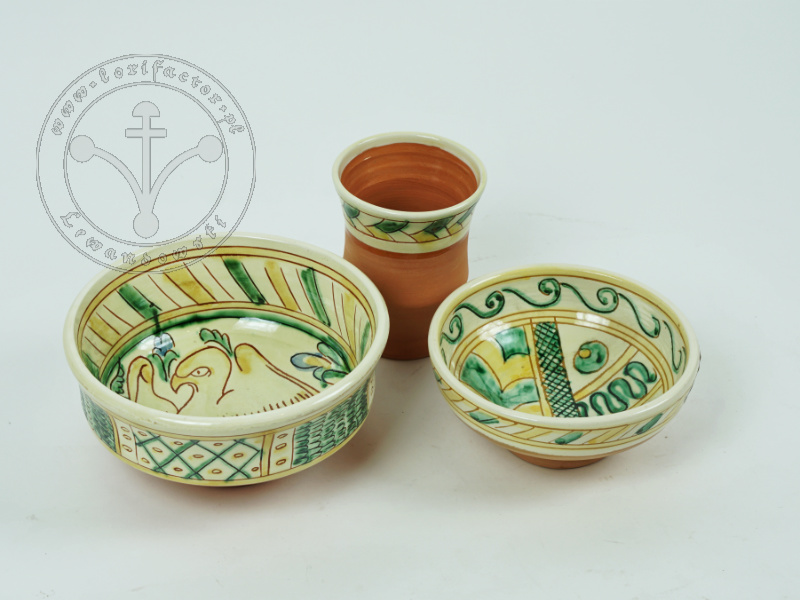
Lorifactor.com is an e-shop offering historical replicas mainly from Medieval age. The replicas are done based on archeological and pictorial sources.
Among selling products you will find belts and knight’s girdles, accessories for belts, armor and dress such as buckles, mounts, buttons etc. and also items of everyday use and weapons such as knives, candlesticks, camp accessories, pottery etc.
Nice approach is done for example with buckles. You may choose from three variants: brass, silver and gold.
Lorifactor is based in Poland (but do not worry, they ship the products also abroad). The products can be ordered throughout Europe in different currencies such as EUR, USD, GBP and CZK, SEK, NOK also.
BBC production about Historical dress reconstructions
Amber Butchart is a fashion historian, a book writer and broadcaster. She presented a six-part series on BBC Four about reconstructing historical dress based on well-known paintings.
Each episode contains a description of tailoring process and techniques from beginning to finishing touches. If you would like to watch the episodes and to know more, they are available on YouTube.
Here are all the episodes of the series with original painting and reconstructed gown.
Amber gets the credits for the series however I have to mention other historian and assistants who participated on the series. They are: Ninya Mikhaila – Historical Costumier, Florence Evans – Art Historian, Jenny Graham – Art Historian, Harriet Waterhouse – Costume Designer and Hannah Marples.
Have a pleasure of watching this series :-).
Which dress you will choose to master your tailoring knowledge?
Hedva is Czech fabric manufacture founded by brothers Schiels in 1890. The company produce from jacquard fabrics (brocades, tie fabrics, tablecloth fabrics) to final products, mostly the accessories for men (ties, bow ties, cloth handkerchief, tailcoat belt) and furnishings (tablecloths, bedclothes, pillowcases, …).
Now let`s focus on brocades ;-). Hedva has wide range of brocades for various purpose – ecclesiastical clergy, national costume, wallpapers, upholstery and of course for historical gowns.
I am also Hedva customer and I may say that I am really satisfied with the service and with the fabric quality. Would you like to know which brocade I bought? It is this beautiful green-blue brocade with dogs and thistles.
This brocade I used to sew medieval surcote. And now it is finished. Have a look…
There are many Hedva customers who sew historical dress. You may get inspirations from them from Hedva photo gallery.
Do you ask yourself: “Where to get sewing pattern of historical dress?”
My answer is: “There is more than one source where to find them.”
The most complex source of historical pattern is company based in Netherlands named Reconstructing history. The company was founded by Kass McGann since 1997. Among selling products include historical dress sewing patterns from medieval age to 20th century (including underwear and accessories), embroidery patterns, books and other dress patterns.
Dress patterns
Accessories and underwear
E-books
It is amazing to have sewing patterns in hand however…..do we understand them? If you have doubts or you want to learn more, you can visit a blog which is a part of the web site.
One of the blog posts of Reconstructing history
I have already bought some of the sewing patterns and one e-book. I may say I was very satisfied with the service. The company is very customer friendly. I highly recommend to visit this web site and read testimonials of other customers.
Another thing I have to mention it that you may buy sewing patterns either in paper or in digital form (perfect idea).






 ajournalofhistorian.home.blog