14th century brings us beginning of fashion and also it`s restrictions. Noble men issued a law to prevent rich merchants and bourgeoisie to wear certain clothing and status symbols.
For example “Pedro El Cruel in 1351 specified that women companions of the clergy were required by law to use striped fabric for their gown“. (Source: Greenwood Encyclopedia of clothing through world history)
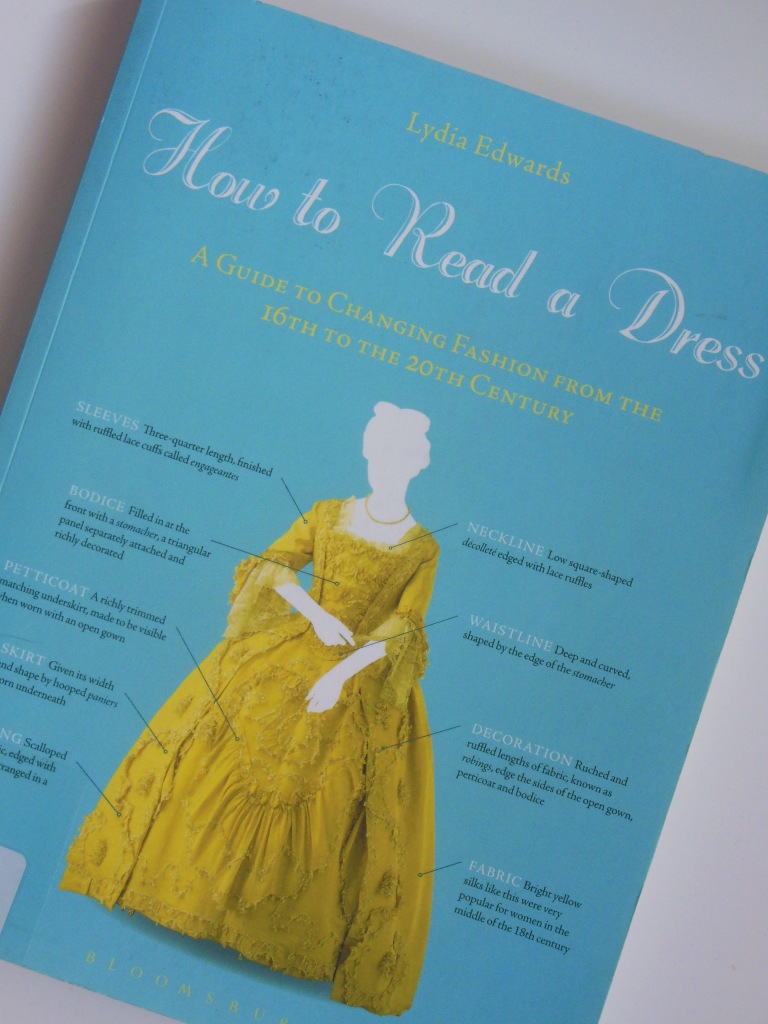
A few weeks ago, I came across a book – How to read a dress written by Lydia Edwards and I would like to share with you my impression.
Before we start to be fully engaged to historical costumes, we need to learn what we see on portraits, fashion plates or real dress exhibited in museums. And here is the question: “How to read what we see?”
This book is full of photos of real garments from the 16th to the 20th century exhibited in the museums all over the world, let`s mention Victoria and Albert Museum – London, McCord Museum – Montreal, Swan Guildford Historical Society – Western Australia. All pictured dress have short description dress itself and description of neckline, sleeves bodice, skirts, trims, fabrics…
When I found this book, I expected the book will contains more details a deeper description such as folding fabric, layering, gathering ruffles etc. In my opinion, there is little information about that. The dress are described in very simple way for example „a square-shaped neckline“, „rounded skirt silhouette“.
I
would recommend this book to beginners as the book contains
vocabulary related with fashion and historical facts and the pictures
show historical features of particular era.
I have learnt to sew many years ago. I sewed casual clothes from skirts and trousers to easy jackets. And than I stopped because it was easier to go to shop and to purchase I wanted.
It changed two years ago. I have started to dance historical dance. And here comes my first historical dress project. I needed something to dress for my first performance. With a little knowledge and little observation I bought a sewing pattern of medieval woman`s dress (specifically not royal dress). The base for my project was the paintings Massacre of the Innocents by Hugo van der Goes and Woman and Unicorn by Robinet Testard (both from late 15th century).
I used Burda sewing pattern 7468. I dare say it is good as a basic pattern which we can adjust. First of all, medieval skirts are wider and you need add a godet (pointed at top and wider at bottom) on both sides of the garment. Secondly you need to adjust breast darts as this is not historically accurate.
Hello friends of historical dress and costumes. I am glad to be here with you and bring you my observations of historical dress, my sewing projects and drawings.
I have to be honest and let you know that I am not professional neither history or sewing. My motivation is my interest in historical dress.
How it started?
When I was round 10, I did several drawings of “historical dress”. These came up from my imagination. “This is how princess looks like…”
In that time (30 years ago…), I had no information about Medieval ages, Renaissance, Victorian or any other era. Here are some of my drawings from my age of 10.
When YOU started to be interested in historical dress?




 ajournalofhistorian.home.blog